.png)


Bird-Watching in Tasmania: Feathered Treasures & Campervan Freedom

Tasmania is a birder’s paradise. With rugged coastlines, forests, wetlands, cliffs, and offshore islands, it offers habitat for many waterbirds, sea birds, parrots, raptors — and a particularly rich suite of endemic species found nowhere else on Earth. By travelling in a campervan you can move at your own pace, chase dawn chorus, stake out roosts, and find quiet spots often missed by organised tours. Below are many of the birds you might see, where, and what to do (including campervan vs guided tours).

Key Bird Species & Where to Find Them
Here are some of the regular, charismatic bird species you’ll likely encounter, plus the Tasmanian endemics to watch for.
Charismatic & Shore/Coastal Species
Blue (or Little / Fairy) Penguins (Eudyptula minor) — small penguins that come ashore at dusk in many coastal nesting sites. Bicheno, Bruny Island, and other sheltered bays are excellent for evening penguin-viewing.
Pied Oystercatcher (Haematopus longirostris) — common along rocky coasts, sandbanks, estuaries. Striking black & white with a strong red/orange beak, often feeding around the intertidal.

Yellow-tailed Black Cockatoo (Calyptorhynchus funereus) — loud, striking, often seen in forests and woodland edges, especially in west and south Tasmania.
Black Swans (Cygnus atratus) — at estuarine wetlands, rivers and lakes. Elegant, often in pairs or small flocks, especially where freshwater meets the sea or near farm dams.
Cape Barren Goose (Cereopsis novaehollandiae) — a large goose, greyish with a black-and-yellow bill, often seen grazing on offshore islands, coastal grasslands and pastures near the sea.
Wild Turkeys (King Island only) — this refers to wild-turkeys (or feral turkeys?) on King Island. If you visit King Island you may see them in rural pastures, farmland perimeters, etc.
Sea Eagle (the White-bellied Sea Eagle Haliaeetus leucogaster) — you may glimpse them soaring over coastal cliffs or gliding over large estuaries / bays. Big, majestic, often nesting in tall trees overlooking good feeding grounds.

Kookaburra — the Laughing Kookaburra (Dacelo novaeguineae) is present in Tasmania (introduced). Their laugh is iconic at dawn or dusk, often perched on tree branches in open forest or near gardens.
Crested Tern (Sterna bergii) — coastal tern, often seen flying over beaches, fishing in shallows, or resting on pylons, rocks or jetties.
Endemic Birds of Tasmania
Tasmania has twelve species of bird that are found nowhere else in the world. Here are these endemics, plus a few additional “breeding endemics” (migrant in/out) you may also see:
Endemic / Breeding-endemic | Key Notes / Where to See |
Green Rosella (Platycercus caledonicus) | The only fully native rosella in Tasmania. Common in open woodland, forest edges. Bright green with yellow head. |
Tasmanian Native Hen (Gallinula mortierii) | Flightless rail, found in open grassy farmland, wetlands, sometimes roadside ditches. |
Dusky Robin (Melanodryas vittata) | Endemic. Found in dry forests and woodlands; perched low, often in undergrowth. |
Tasmanian Thornbill (Acanthiza ewingii) | Small bushbird, found in scrub / forest understory. |
Scrubtit (Acanthornis magnus) | More elusive; forested areas. |
Tasmanian Scrubwren (Sericornis humilis) | Understory of wet forests, damp gullies. |
Yellow Wattlebird (Anthochaera paradoxa) | One of the larger honeyeaters; noisy; in flowering eucalypts. |
Yellow-throated Honeyeater (Nesoptilotis / Lichenostomus flavicollis) | Common in woodlands and scrub. |
Black-headed Honeyeater (Melithreptus affinus) | Forests, mixed woodland. |
Strong-billed Honeyeater (Melithreptus validirostris) | More specialist foragers, searching in bark and trunks. |
Black Currawong (Strepera fuliginosa) | Troops in forests and mountains; occasionally edges. |
Forty-spotted Pardalote (Pardalotus quadragintus) | Very rare. Mostly in southeast Tasmania, Bruny Island and Maria Island. Habitat restricted to white gum / dry eucalypt forests. |
Also, note the Orange-bellied Parrot and Swift Parrot are breeding migrants in Tasmania (breeding endemic in that sense) — highly endangered and worth trying to see if in season.

Where Bird-Watching & Species Overlaps with Lighthouses / Coastal Spots

Many of your lighthouse stops provide excellent opportunities for bird-watching, especially around coastlines, estuaries, offshore islands, cliffs, and bays. Here are some synergies to consider:
Near lighthouses and pilot stations (for example, Low Head Pilot Station) you often have estuarine zones, mudflats or river mouths — places where oystercatchers, sea eagles, black swans, capes etc congregate, especially early morning or at low tide.
Offshore islands and rock platforms near Cape Bruny, Bonnet Island, Cape Wickham etc may host seabirds, roosting birds, and geese like Cape Barren Geese, especially if there is grassy land and shelter.
Coastal shrub and woodland near these lighthouses often attract parrots (green rosella, swift/orange-bellied in season), honeyeaters, and endemic forest birds when you move slightly inland from the shore.
Sample Highlights: Combining Birding + Lighthouses + Campervan
Here are a few “destination snapshots” of places you might stay or pass, where you could both enjoy the lighthouse and birdwatching:
Low Head Pilot Station: Watch waterbirds, sea eagles over Tamar estuary; possibly black swans; penguins at dusk; good woodlands nearby for rosellas and other woodland birds.
Bonnet Island / Strahan: Sea birds, shorebirds, perhaps Cape Barren Geese; evening penguin tours; rainforest edges near Strahan for endemic forest birds.

Cape Wickham, King Island: Unique island birdlife, plus King Island’s “wild turkeys”, pastoral edges, coastal vantage points for seabirds & raptors; parrots and honeyeaters inland.
Bruny Island & environs (Cape Bruny area): Great for endemic forest birds, plus seabirds, penguins, and possible sightings of the rare forty-spotted pardalote in appropriate habitat. Also good vantage for shorebirds and sea eagles.
Why Endemic Birds Matter & Some Tips for Finding Them
Endemics are species you won’t find elsewhere — they make Tasmania very special as a birding destination.
Some are quite common (green rosella, yellow-throated honeyeater, currawong), others are very rare (forty-spotted pardalote, orange-bellied parrot).
Listening is often as important as seeing: calls of honeyeaters, currawongs, robins, etc, can guide you into dense canopy.

Campervan Versus Guided Tours: The Best of Both Worlds
Travelling by campervan gives you massive flexibility:
Rise early or stay late for prime bird-watching times (dawn, dusk).
Follow your own pace: linger where birds are active, shift if conditions change (weather, tides, etc.).
Sleep close to your birding spots; minimal travel time in early morning.
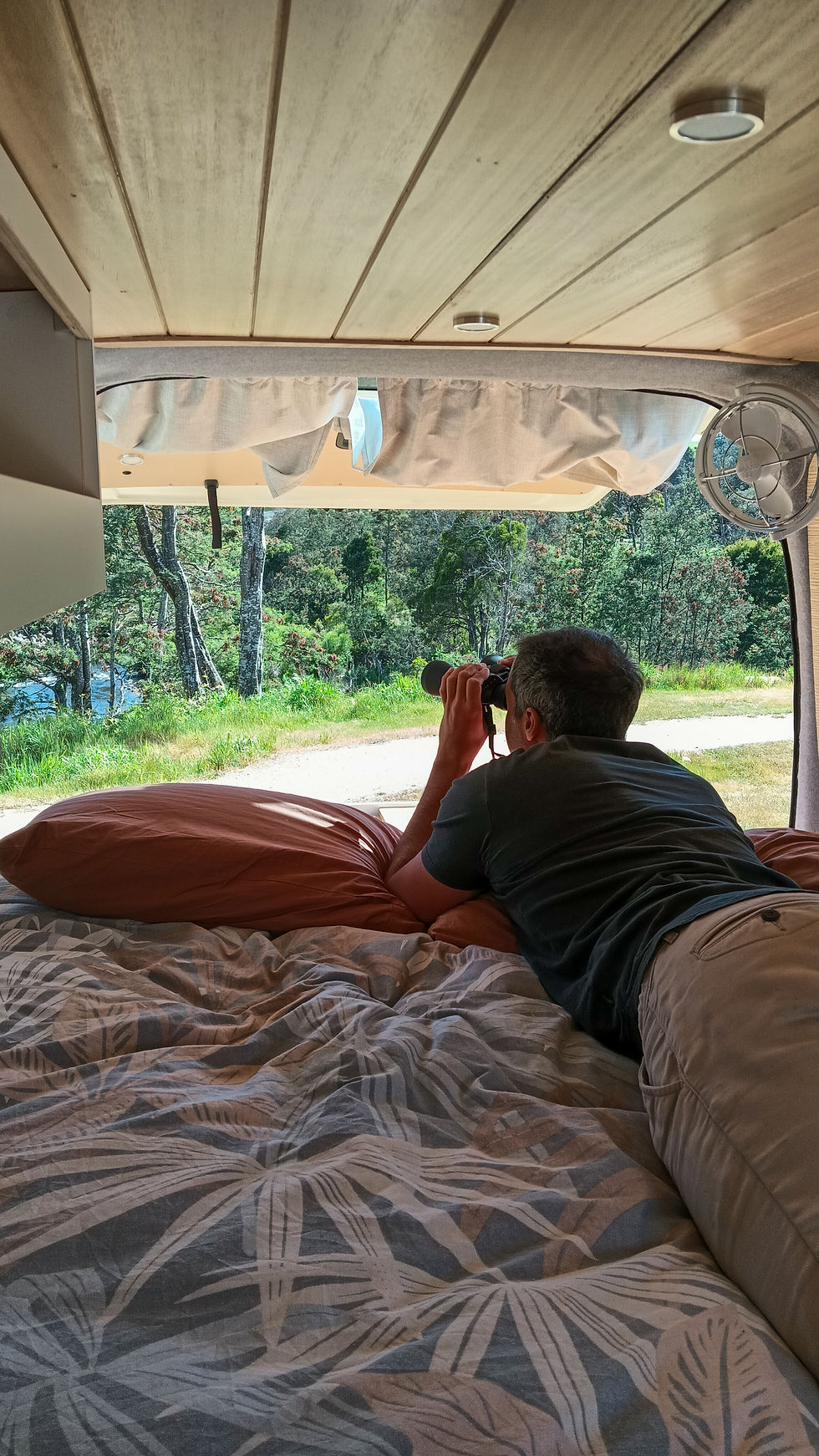
Use the binoculars we provide in each campervan rental and field guide, maybe a spotting scope, bird record app, etc.

But guided tours have their advantages: local knowledge, access to private or restricted habitat, safety in knowing where rare species may be, and less logistical planning. Two examples:
Inala Nature Tours — their “Tasmanian Endemic Birds of Hobart” tour focuses on finding many of the endemic species around Hobart within a half hour drive.
Bicheno Penguin Tour — excellent for penguins (blue / fairy penguins) at dusk, combining coastal scenery with wildlife.
Putting It All Together: A Bird-Watching Campervan Roadtrip Plan (Sketch)

Here’s a rough idea of how you might plan your trip to maximize birdwatching + lighthouse viewing + enjoying Tasmania in a campervan:
Start in Hobart. Before you even leave the city, explore nearby woodland, estuaries and parks for green rosellas, yellow-throated honeyeaters, currawongs, etc.
Head south / southeast to Bruny Island (Cape Bruny) — stay in a coastal campground. Time your visit so you get both sunrise/sunset, penguin shore trips, seabird roosts, and woodland trails.
Move north-east along the east coast, stopping at lighthouses / coastal headlands (e.g. Eddystone Point) with birding zones. Shorebirds, terns, sea eagles, geese may be present.
Cross over (if possible) to Maria Island / for specialist birds (Cape Barren Goose) and the island stunning coastlines.
Go north-west coast, stopping at Low Head, estuaries, river mouths; then inland forest tracks and woodlands once you leave the coast to seek more endemics.
12 Endemic Tasmanian Birds You Can Try to See

To summarise, here are the 12 true endemics of Tasmania:
Green Rosella (Platycercus caledonicus)
Tasmanian Native Hen (Gallinula mortierii)
Dusky Robin (Melanodryas vittata)
Tasmanian Thornbill (Acanthiza ewingii)
Scrubtit (Acanthornis magnus)
Tasmanian Scrubwren (Sericornis humilis)
Yellow Wattlebird (Anthochaera paradoxa)
Yellow-throated Honeyeater (Nesoptilotis flavicollis)
Black-headed Honeyeater (Melithreptus affinus)
Strong-billed Honeyeater (Melithreptus validirostris)
Black Currawong (Strepera fuliginosa)
Forty-spotted Pardalote (Pardalotus quadragintus)
Plus, the Orange-bellied Parrot and Swift Parrot are critically endangered breeding migrants in Tasmania that are worth trying to catch (if your timing is right).
Tips for Gear, Timing, and Etiquette
Dawn and dusk are prime times: many coastal birds and penguins are active then.
Check tides: shorebirds and oystercatchers feed at low tide.
Bring good binoculars, maybe a small spotting scope; camera with zoom if interested in photography.
Respect nesting areas; keep distance from wildlife, especially penguins and rare parrots.
Be weather-ready: Tasmania’s weather can change quickly; rain, wind, fog can affect both bird activity and safety around cliffs, coast.
Tour & Travel Partners Worth Considering
Inala Nature Tours — great to cover many endemics with a guide, especially near Hobart.
Bicheno Penguin Tour — excellent for seeing blue/fairy penguins at dusk, combining coastal scenery and wildlife.
Pennicott Wilderness — Probably the best way to combine sealife with birdlife with tours departing from Bruny Island, Freycinet and Port Arthur.
Tasmania is more than just rugged coastlines and pristine wilderness—it’s a true haven for bird lovers. From spotting little blue penguins waddling ashore in Bicheno, to hearing kookaburras laugh in eucalyptus groves, or watching sea eagles soar over wild headlands, each day brings a new highlight. Add to this the chance to see Tasmania’s 12 endemic species—such as the green rosella, forty-spotted pardalote, and Tasmanian scrubwren—and your birdwatching adventure becomes truly unforgettable.

Hiring a campervan gives you the freedom to follow the flocks at your own pace—waking up by wetlands to see black swans at dawn, or camping near coastal cliffs where pied oystercatchers feed. For those who prefer expert guidance, organised experiences like Inala Nature Tours or the Bicheno Penguin Tour offer deeper insights into Tasmania’s unique birdlife.
Whether you choose the independence of a campervan road trip or the expertise of a guided tour, Tasmania’s skies, shores, and forests promise a birdwatching journey like nowhere else in the world.


Comments